

A scope of work sets out the work in a project or work package. It names the results, who supplies what, and how the team will review them. For a software handoff, it should also state what is left out and how changes are agreed. It gives the founder and build team a shared plan to discuss when a new request arrives.
Consider a private prototype to collect and sort feedback. Assume 40 hours of effort. Adding a second export format appears small, but it changes the package unless something else moves out.
This guide follows that request from the first handoff through a proposed change. The hours are invented; they are not a market quote.
What a scope of work covers
Ask what the team can build and the reviewer can check from this document. A feature name alone rarely answers it. “Feedback dashboard” leaves key points open.
Who uses it? Which records appear? What can users do, and how will the team check that it works?
Describe the package at a level that makes those boundaries clear. A product backlog can hold ideas beyond the package. A checklist can spell out how each result should work.
The handoff links the chosen work, its inputs, its reviewer and its limits. There is no need to copy every ticket into one document.
Scope of work vs statement of work
Teams use these terms in different ways. Some use “statement of work” for a broader document with business terms and a scope section.
Others use both names for the same thing. Spell out what your document contains and define “SOW” before using it with a supplier.
This worksheet describes work and decisions. It does not settle the legal effect of a document.
Seek advice about the terms of your own agreement when needed. A title, signature field or template cannot answer that question by itself.
A baseline can change
Write down the starting agreement so changes can be discussed. That does not require freezing every detail forever. The November 2020 Scrum Guide, for example, allows scope to be clarified and renegotiated with the Product Owner as learning occurs, while protecting the Sprint Goal.
That rule belongs to Scrum. For this worksheet, record what changed and who decided. An extra request should not become part of the first package without that discussion.
Write the handoff fields
Start with the user and the result the package should enable. If the problem is unclear, use customer discovery to gather evidence.
Check what you think you know before you commit to building it. A clear work description still needs a reason for the work.
Use the following as a compact scope of work template. Fill each field with facts about your project.
For any point “to be agreed,” name an owner and a next step. Do not hide a missing input behind vague wording.
| Field | What to record |
|---|---|
| Goal and user | Who needs the result and what they need to do |
| Included work | Deliverable IDs, boundaries and expected behavior |
| Exclusions | Related work that this package does not cover |
| Inputs and owners | Who supplies examples, access, decisions and reviews |
| Dependencies | Conditions that must hold before work or review starts |
| Review evidence | How each deliverable will be checked and by whom |
| Capacity and milestones | Effort assumptions, reserve and review points |
| Change record | Version, affected IDs, decision owner and status |
Write results that someone can assess. FAR 37.602 offers one public example. In US federal performance-based acquisition, it calls for required results and a way to measure them.
Use it to see how a work description can focus on results. Its rules do not govern every private software project.
Keep an input separate from the work it enables. “Founder supplies test access” is not the same as “team builds production authentication.”
If access is missing, name the blocked work and who can fix it. Set a point to review the plan again.
Pair each result with evidence. GOV.UK’s user-story guidance connects the user’s goal with acceptance outcomes and supporting evidence.
For this handoff, name what the reviewer will see. A general “client approval” box does not tell them what to check.
Keep money and time assumptions explicit too. Use an MVP cost model when you need to turn a wider build plan into a budget.
The hours below are assumed effort. They are not a price or a promise about how many days the work will take.

The access card is still being handed over outside the closed test room.
Follow one software work package
This simple scope of work example is for a fictional B2B feedback prototype. A test user submits feedback, and a designated product owner reviews it.
It runs in a private test environment with made-up records. Test identity and access are already supplied.
Those conditions matter. The package excludes real customer data, production deployment and authentication, SSO, multitenancy, billing, CRM integration, mobile apps and production operations. It is not an estimate for a production SaaS product.
The founder supplies the categories, synthetic examples, reviewer and agreed export fields. The delivery team implements D1–D3; both sides take part in D4.
These roles belong to the example. No real client or team has approved this work.
| ID | Included result | Input or owner dependency | Review evidence | Assumed effort |
|---|---|---|---|---|
| D1 | Intake with title, description and agreed category | Founder supplies categories and synthetic examples | Agreed valid/invalid inputs and returned record ID | 8 h |
| D2 | Triage list, open/resolved status and filter | Founder names reviewer and states | Submit a record, change its state and check the filter | 14 h |
| D3 | CSV of the filtered list with agreed columns | Founder agrees export fields | Compare synthetic rows with the filter and output format | 6 h |
| D4 | Review, handoff notes and walkthrough | Joint review; founder supplies reviewer and review window | Run notes, limitations and unresolved items | 8 h |
The work adds up to 36 hours: 8 + 14 + 6 + 8. A separate four-hour reserve brings the total to 40 hours.
The reserve is an example choice. It is not a rule for how much spare time software work needs.
Use the IDs to keep the review concrete. For D1, agree which fields are required. Decide how to handle an invalid category before the walkthrough.
For D2, change a record’s state and check the filter again. A screen that loads is not enough evidence.
For D3, compare the exported rows with the same filtered synthetic records. Agree column names and output format before checking the file.
Save the results under D3. A later export change then has a clear point of reference.
For D4, keep failed or blocked checks visible in the handoff notes. A walkthrough may expose a missing input or an open issue. Holding the meeting does not mean all results passed.
Record the next action and who owns it. Do not mark a result complete without the agreed evidence.
Use three review points. At M0, agree inputs, environment and access. At M1, review D1 and D2. At M2, review D3 and the D4 handoff.
Their order reflects dependencies. Forty hours does not imply five days. People may have other work, and reviews may involve waits.
Some prototypes aim to test an unknown. A proof-of-concept decision plan can define the evidence needed to justify more work. Keep that learning decision separate from a claim that the prototype is ready for customers.
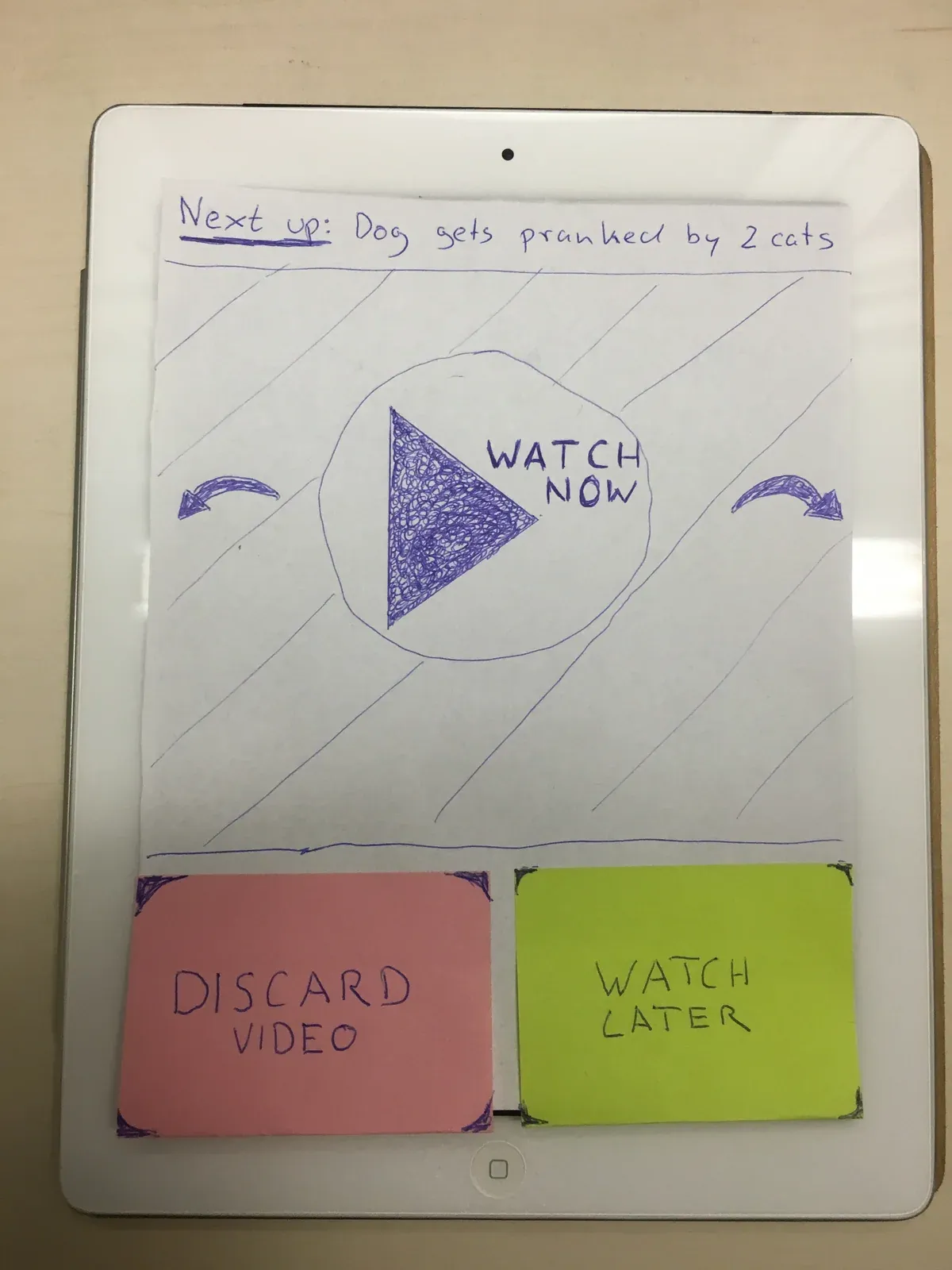
This separate paper prototype shows video choices drawn over an iPad screen.
Record a request before changing the baseline
Request R1 asks for a second export format. Assume six hours of extra effort. First record who asked, why, and the evidence behind the request.
Name the work it affects and what else it needs. Agree the format and how to check it before relying on the six-hour estimate.
D3 is the obvious affected result, but review work may change too. Recheck D4 and the other assumptions before accepting the estimate in a real project.
The sums below assume six hours covers all the extra work. That is a made-up estimate for this example.
| Proposed choice | Calculation, preserving the reserve | Result |
|---|---|---|
| Defer R1 | 36 + 4 = 40 h | Original package remains; R1 stays outside it |
| Add without a trade | 36 + 6 + 4 = 46 h | Six hours above the original assumption |
| Swap D3 for R1 | 36 − 6 + 6 + 4 = 40 h | Original CSV work leaves the package |
| Explicitly resize | (46 − 40) ÷ 40 × 100 = 15% | Capacity assumption increases by 15% |
A swap needs a plain statement of what disappears. If D3’s CSV is removed, do not mark its review complete.
Describe R1 as the new export. Check that the person who needs the CSV understands the proposed loss.
A resize keeps both exports. It needs a new decision about effort and any linked work. Fifteen percent is the result of this sum.
It does not tell you the change in price or days. Do not consume the reserve silently to make added work appear to fit.
Keep v0. Draft a proposed v1 with the reason, affected IDs, change in effort and decision owner. Mark it proposed until the people with authority decide.
If the request is deferred, keep its record. The team can revisit the evidence later without treating it as promised work.
For example, the proposed R1 record could say that the test reviewer wants to read the export in a second tool. That reason is part of this fictional case, not proven user demand. Ask for a sample file or a clear format choice before refining the estimate.
Link the record to D3 and note that D4 needs a fresh export check. Leave the decision pending, name the founder as the proposed decision owner, and list the team member who will check the effort. A request can be well described and still wait for a decision.
When that decision is made, record its date and basis in the live project. Do not prefill a date or an approval in a reusable worksheet. Share the changed version with the people who must build, supply inputs and review the result.
A prioritization worksheet can help compare the value of competing requests. This change log has a narrower job. It shows how that choice would alter the agreed package.

Lifting the proposed overlay leaves the original sheet intact and visible.
Review the handoff together
Read the document from both sides before work begins. Can the delivery team identify the inputs it needs? Can the reviewer point to the evidence for each result?
Ask each owner to confirm their part. Leave missing answers visible with a next action.
Check the limits against actual capacity. A founder bootstrapping a startup may have little time for reviews as well as build work.
Agree a review window both sides can meet. Free time to build does not mean free time to decide.
For more context, watch ProjectManager’s How to Write a Scope of Work Document. Jennifer Bridges walks through the document in this training video. The older video offers background.
It is not legal authority or proof of this worksheet’s hours. The publisher page links the exact video shown below.
Before handing over, confirm the current version and its status. Check open inputs, review evidence and the next decision. Label a proposal as a proposal.
Keep a completed task distinct from a passed review. Then a request for “one more thing” has a specific result, trade and owner to discuss.