

AI dependency can mean relying on a tool for answers, judgments or support that a person struggles to supply alone. Those are different outcomes. A 2026 controlled preprint found worse task results when AI help was removed.
For a software team, the practical question is what people can still solve, explain and check when the tool is off. Frequency of use alone does not answer that.
What AI dependency means in these studies
A useful AI dependency definition starts with what you want to check. Asking a tool to summarize a document shifts where that work happens. Accepting its false claim is a failure of checking.
Feeling unable to work without it is a report of how the user feels. These can overlap, but one does not prove the others.
| Construct | What to observe | What that observation leaves open |
|---|---|---|
| Cognitive offloading | A person uses a tool for part of a task. | Whether that helps or harms later work without the tool. |
| Overreliance on advice | A person accepts advice that is wrong. | Whether they could detect the error when the task or tool changes. |
| Perceived dependence | A person says they feel they need the tool. | What they can do when it is off. |
| Problematic emotional use | A study measures distress, emotional dependence or problematic engagement. | Whether an individual meets any clinical diagnosis. |
Model quality and human skill also need separate checks. A correct answer can leave what the user knows untested. A wrong answer can be caught by someone who checks the evidence.
Verified hallucination cases concern output failures; they do not measure what every user can do alone.
For a team, name the skill worth keeping before you choose a metric. That might be tracing a failed request, reviewing an access rule or explaining why a test fails. “Uses AI often” does not specify which of those abilities is missing.
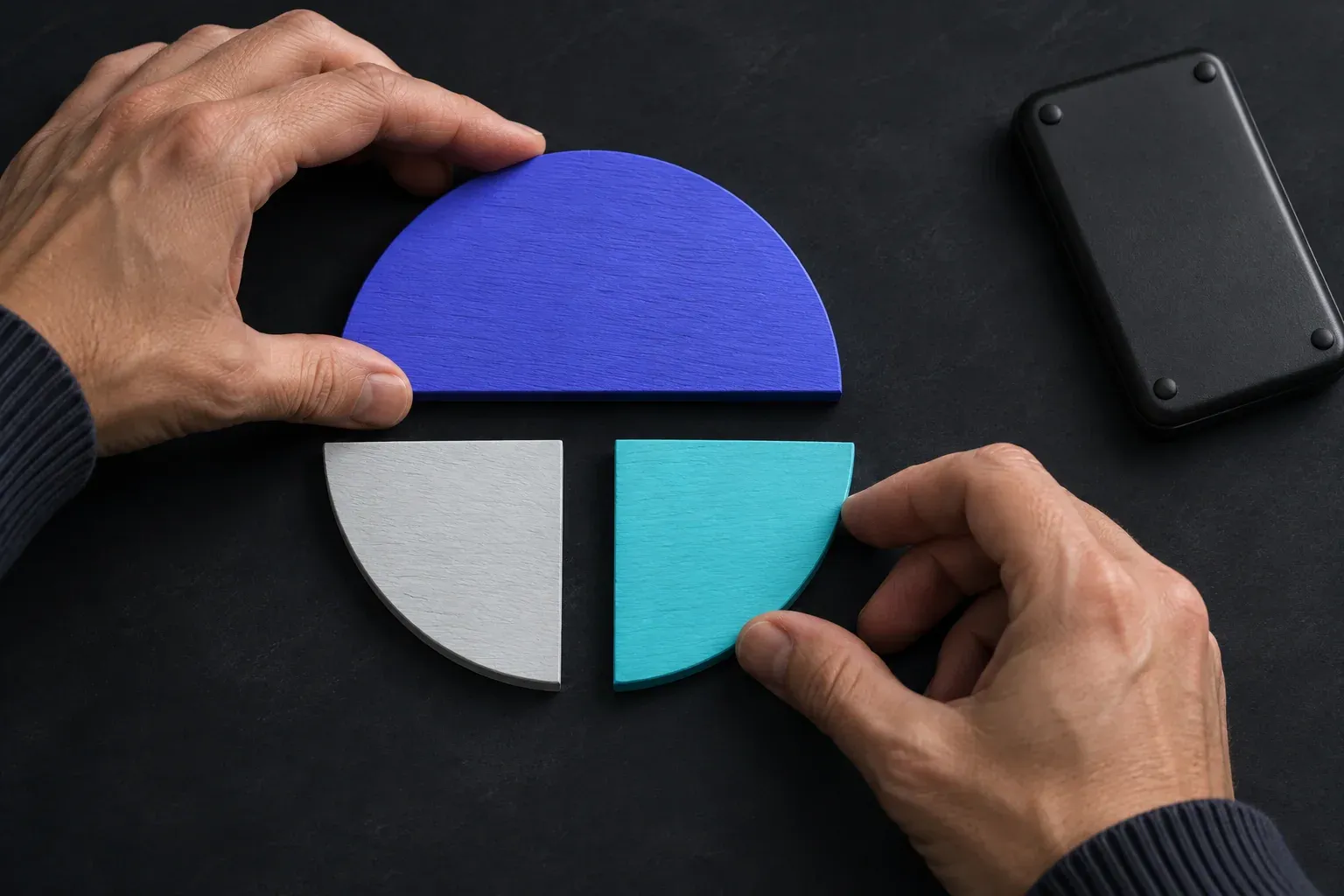
Hands arrange fraction pieces while a calculation aid lies face down.
What people did after AI assistance was removed
The October 2026 controlled study
Liu and colleagues’ preprint, version 6 dated October 13, used GPT-5 assistance followed by immediate unaided fraction or reading tasks. Across three experiments, 1,222 people were recruited; 1,058 remained after exclusions. These are different sample counts.
In experiment 2, with 585 retained participants, unaided solve rates were 0.71 with prior AI assistance versus 0.77 in the control group (p = .019). Skip rates were 0.10 versus 0.07, a difference that was not statistically significant (p = .239).
That experiment used a pretest to address the first experiment’s ability-based exclusion confound. The result supports a bounded concern about immediate independent performance. It does not establish lasting skill loss, coding performance or addiction.
The arXiv record still identified v6 as the latest version when checked on November 11, 2026; this article treats it as a preprint.
Surveys ask different questions
The CHI 2025 study by Lee and colleagues collected 936 work examples from 319 knowledge workers. Higher confidence in GenAI was associated with less reported critical engagement; higher self-confidence with more. The study concerns perceived effort and practice, rather than a test that randomly assigned tool use and measured lost skill.
A 2025 study of 420 university participants in Bogotá examined perceived dependence among frequent AI users. Its 32-item AI dependency scale was adapted from a social-media scale, with a 20-person validation pilot. Participants also made hypothetical choices between AI access and money.
The authors reported low average perceived dependence. Neither those choices nor that scale measured performance after removing assistance.
The difference matters when reading AI dependency research. A survey can reveal how people describe their behavior.
A task test can show what they did on a set task. Calling one the other does not make the evidence stronger.
| Study and version | Design and measured outcome | Boundary to retain |
|---|---|---|
| Liu et al., October 2026 v6 | Randomized assistance followed by an immediate unaided test. | Task performance and skipping are separate outcomes. |
| Lee et al., CHI 2025 | Work examples and self-reported critical-thinking effort. | Association and perceived effort. |
| Robayo-Pinzon et al., August 2025 | Adapted dependence scale and hypothetical monetary choices. | Selected university sample; low average reported dependence. |
| Fang et al., October 2025 v2 | Four weeks of chatbot use with randomized modes and conversation tasks. | Psychosocial outcomes, not independent coding ability. |
Emotional dependence needs its own evidence
Fang and colleagues’ revised study followed 981 participants using GPT-4o over four weeks. The abstract reports no significant effects from the assigned conditions. The results discuss some nominal contrasts, including personal conversations, that require care with statistical corrections.
The broad finding should not be rewritten as proof that all conditions are equivalent.
Heavier voluntary use was associated with worse psychosocial outcomes. People chose how much to use the tool.
The link between time and outcome does not show that an extra minute caused harm. It also answers a different question from whether a developer can debug without help.
What these studies cannot tell us
There is no single result here that answers “Are we dependent on AI?” for every person, task and tool. The phrase groups several questions. The studies count different things: task answers, work examples, scale scores and chatbot use.
Keep the person, task and time window together. A result from one task should stay tied to that task.
Moving from a brief test to a claim about an entire career needs tests across tasks and time. Moving from a student sample to a software team means checking who took part and what they did.
Separate a result from an explanation for it. A gap in results can be measured. Why it appeared is a separate question.
A study must test a cause before claiming that it explains the gap. Faster access to answers, practice, rewards and what people expect are reasons to ask better questions. They do not measure brain damage or a loss of skill in every user.
Treat low and nonsignificant findings as part of the answer. A low mean score in one sample does not rule out problems for some people.
A nonsignificant contrast does not prove two conditions have identical effects. Keep both points in view when reading a broad headline.
Do not turn a questionnaire into an employee diagnosis. A scale may help answer the question it was designed to study. It does not give a workplace dashboard a proven cutoff for harm.
Usage counts, a missed answer and a person’s confidence tell you different things. A single score made from all three would need its own evidence.
For product teams, Goodhart’s law helps explain why the choice of target matters. Faster assisted completion and more engagement can look like success while no one checks what users can do alone. Keep both outcomes visible rather than using a count of actions in place of the goal.
How a team can check independent performance
The following is a proposed team check using practice tasks and consent. It is not a test for a clinical diagnosis. Keep tasks out of production and use approved tools.
Explain when help is allowed, what you record, who sees it and how the team will use the results. Do not collect personal chatbot conversations or mental-health data for this exercise.
Define a capability and a fair comparison
Choose one small work task. For example, ask people to inspect a small function, identify its failing edge case and propose a test. Use made-up code and state what it should do.
A vague task such as “be productive” does not say which skill the tool may take over.
Prepare matched task versions before the session. Match the concepts, context people can use and scoring rule, rather than reusing the same answer with renamed variables. Have someone else check the tasks.
Note which tasks are harder. A harder final task could explain a worse score even if tool use had no effect.
Start with a baseline without AI. Then try a task with AI and a matched task without it. Where you can, vary task order across people so the same version is not always last.
Record practice, fatigue, breaks and whether people knew the task. Tell participants about the planned phases; a surprise loss of access adds another change to explain.
Keep the data boundary clear. The shadow-AI inventory approach helps identify approved tools and permitted inputs. A useful skill check does not need client data or production credentials.

A person attempts a wooden puzzle with a reference card set aside.
Preserve the denominators
Keep raw counts as well as percentages. Keep assigned, attempted, correct and skipped tasks separate, with a rule for partial answers. Otherwise, a person who tries only easy questions can score well while doing less work.
| Field | Why keep it |
|---|---|
| Task version and scoring rule | Shows a reviewer what counted as correct. |
| Baseline result | Shows what the person could do at the start. |
| Assistant, model and configuration | Records which help was on offer. |
| Assisted correct and attempted counts | Shows results with the tool present. |
| Unaided correct / attempted | Shows how many tried tasks were solved. |
| Unaided skipped / assigned | Shows which tasks were not tried. |
| Time, explanation and verification evidence | Shows how the result was reached and checked. |
Read the accuracy and skip measures together. A change in one does not settle the other.
Include the underlying counts in the review, especially when there are few tasks. Avoid a league table of people based on a small set of tasks.
Keep model changes separate from human changes. The model-drift guide explains why changed system behavior needs its own record. If the assistant, task or instructions changed between sessions, note that before saying a score change shows a change in skill.
Test the manual path and choose a response
Ask each person to explain one answer and show how they would verify it. For a debugging task, that might mean pointing to the input that triggers the failure and running a focused test. Do not count a fluent explanation alone as evidence that the proposed fix works.
Agree in advance what would trigger another review. If assisted work passes but the unaided task exposes a gap, the team could narrow the assistant’s role, add practice or revise the workflow. Those are options to evaluate.
Name an owner and a follow-up task. One session is not enough to label a lasting trait.
Also try the ordinary fallback: can the team find the source documentation, reproduce the issue and hand the work to another person? A manual path that exists only in a policy document still needs to be tried. Keep the result tied to the task and conditions tested.
Design options and their tradeoffs
Making an answer easier to check is a more concrete design goal than asking users to “trust appropriately.” Vasconcelos and colleagues studied simulated AI advice in maze tasks across five studies with 731 participants. Task difficulty, explanation difficulty and incentives affected overreliance.
An explanation helped under some conditions; its mere presence was not a universal fix.
The author’s paper video below, linked by Stanford HAI, gives context for that verification-cost question. It concerns maze decisions, not a trial of a modern coding assistant.

A fingertip inspects a maze channel beside a separate route sketch.
Buçinca, Malaya and Gajos tested forcing designs in a 199-person meal-decision experiment with simulated AI. The designs reduced overreliance relative to simple explanations, but the most effective designs received less favorable subjective ratings. Extra effort can be part of the tradeoff.
For a product test, compare source access, a request for an initial judgment, or hints before a full answer. Measure errors, effort and later independent work as separate outcomes. Sycophancy is another reason to check evidence rather than accept a response because it agrees with the user.
The useful question is what the person can do with and without the tool, under which conditions. Name the skill, keep each study’s limits in view, and test the workflow before claiming it helps people retain that skill.